
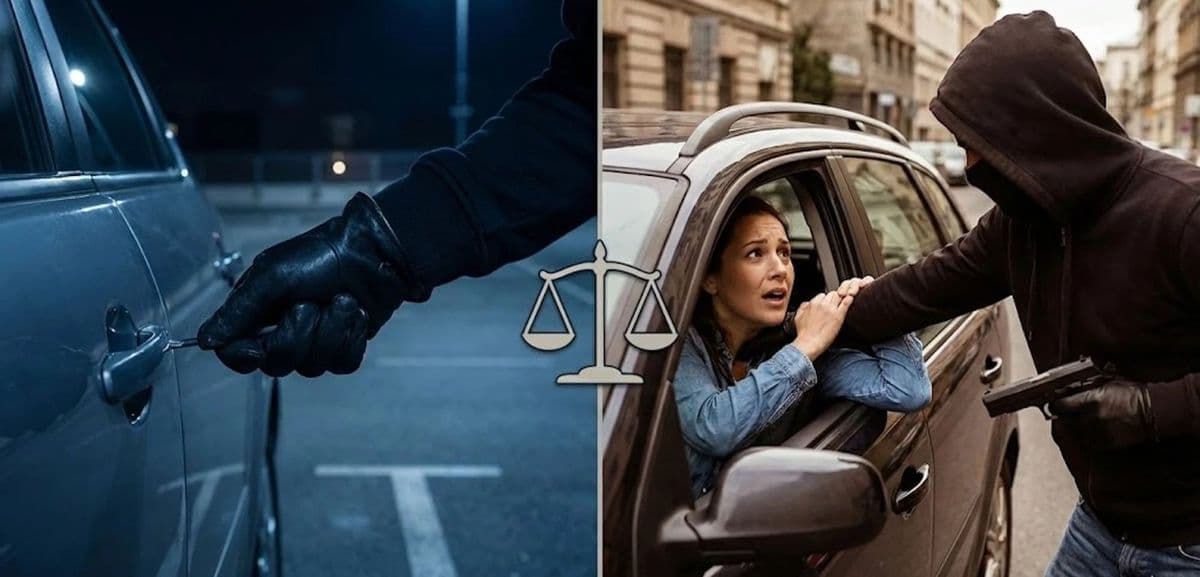
“Carjacking” and “Auto Theft” are often used interchangeably in casual conversation, but in a Minnesota courtroom, they’re two entirely different worlds.
One is a property crime; the other is a violent felony against a person.
Understanding this legal distinction explains why two teenagers arrested for “stealing cars” can face drastically different fates—one released to their parents, the other certified as an adult facing a decade in prison.
Auto Theft (Theft of Motor Vehicle)
The Statute: MN Stat. 609.52
The Act: Stealing a parked, unoccupied vehicle. This is the realm of the “Kia Boyz“—using a USB cable to hotwire a sedan while the owner is asleep or shopping.
The “Force” Factor: Zero. There is no confrontation with the victim.
The Penalty: Felony Theft.
Standard: Up to 5 years in prison (if vehicle value is under $5,000).
High Value: Up to 10 years (if value exceeds $5,000).
The Reality: For first-time juvenile offenders, this often results in probation, diversion programs or a quick release to parents. In 2024, auto thefts statewide actually dropped by 19.3%.
The Statute: MN Stat. 609.52
The Act: Stealing a parked, unoccupied vehicle. This is the realm of the “Kia Boyz“—using a USB cable to hotwire a sedan while the owner is asleep or shopping.
The “Force” Factor: Zero. There is no confrontation with the victim.
The Penalty: Felony Theft.
Standard: Up to 5 years in prison (if vehicle value is under $5,000).
High Value: Up to 10 years (if value exceeds $5,000).
Standard: Up to 5 years in prison (if vehicle value is under $5,000).
High Value: Up to 10 years (if value exceeds $5,000).
The Reality: For first-time juvenile offenders, this often results in probation, diversion programs or a quick release to parents. In 2024, auto thefts statewide actually dropped by 19.3%.
Carjacking (The New Statute)
The Statute: MN Stat. 609.247 (Enacted 2023)
The Act: Taking a vehicle from a person using force or threat of force. This includes pulling a driver out of a seat, implying you have a weapon, or pointing a gun.
The “Force” Factor: High. This is classified as a “Crime Against Persons,” placing it in the same severity tier as assault and robbery.
The Penalties:
Third-Degree (Simple Force): Up to 10 years. (e.g., yanking a driver out by their coat).
Second-Degree (Implied Weapon): Up to 15 years. (e.g., hand in pocket simulating a gun).
First-Degree (Armed/Bodily Harm): Up to 20 years. (e.g., pointing a firearm or striking the victim).
The Trend: While auto thefts are down, carjackings rose by 5.5% in 2024, with 426 incidents reported statewide.
The Statute: MN Stat. 609.247 (Enacted 2023)
The Act: Taking a vehicle from a person using force or threat of force. This includes pulling a driver out of a seat, implying you have a weapon, or pointing a gun.
The “Force” Factor: High. This is classified as a “Crime Against Persons,” placing it in the same severity tier as assault and robbery.
The Penalties:
Third-Degree (Simple Force): Up to 10 years. (e.g., yanking a driver out by their coat).
Second-Degree (Implied Weapon): Up to 15 years. (e.g., hand in pocket simulating a gun).
First-Degree (Armed/Bodily Harm): Up to 20 years. (e.g., pointing a firearm or striking the victim).
Third-Degree (Simple Force): Up to 10 years. (e.g., yanking a driver out by their coat).
Second-Degree (Implied Weapon): Up to 15 years. (e.g., hand in pocket simulating a gun).
First-Degree (Armed/Bodily Harm): Up to 20 years. (e.g., pointing a firearm or striking the victim).
The Trend: While auto thefts are down, carjackings rose by 5.5% in 2024, with 426 incidents reported statewide.
Why ”Certification” Matters
The most critical difference is how these charges affect juveniles (ages 14-17).
Auto Theft: Almost never results in “Adult Certification.” The teen stays in the juvenile system, which prioritizes rehabilitation. Records are not sealed at age 18. A juvenile court may expunge delinquency records at any time if it finds the benefit to the person outweighs the detriment to the public and public safety and the burden on courts and agencies. Some records also qualify for automatic expungement, such as when all charges were dismissed.
Carjacking: Because it is a violent felony, prosecutors can move to “certify” the teen as an adult. Certification is possible for any felony committed at age 14 or older.
Presumptive Certification: If the juvenile used a firearm (First-Degree Carjacking), the court presumes they should be tried as an adult. The burden flips to the defense to prove why they shouldn’t be.
EJJ (Extended Juvenile Jurisdiction): A middle ground where the teen gets a “stayed” adult prison sentence. If they violate the conditions of the stayed sentence before age 21, the court can revoke the stay and send them to adult prison. It is not automatic, and the offender can challenge the revocation at a hearing.
Auto Theft: Almost never results in “Adult Certification.” The teen stays in the juvenile system, which prioritizes rehabilitation. Records are not sealed at age 18. A juvenile court may expunge delinquency records at any time if it finds the benefit to the person outweighs the detriment to the public and public safety and the burden on courts and agencies. Some records also qualify for automatic expungement, such as when all charges were dismissed.
Carjacking: Because it is a violent felony, prosecutors can move to “certify” the teen as an adult. Certification is possible for any felony committed at age 14 or older.
Presumptive Certification: If the juvenile used a firearm (First-Degree Carjacking), the court presumes they should be tried as an adult. The burden flips to the defense to prove why they shouldn’t be.
EJJ (Extended Juvenile Jurisdiction): A middle ground where the teen gets a “stayed” adult prison sentence. If they violate the conditions of the stayed sentence before age 21, the court can revoke the stay and send them to adult prison. It is not automatic, and the offender can challenge the revocation at a hearing.
Presumptive Certification: If the juvenile used a firearm (First-Degree Carjacking), the court presumes they should be tried as an adult. The burden flips to the defense to prove why they shouldn’t be.
EJJ (Extended Juvenile Jurisdiction): A middle ground where the teen gets a “stayed” adult prison sentence. If they violate the conditions of the stayed sentence before age 21, the court can revoke the stay and send them to adult prison. It is not automatic, and the offender can challenge the revocation at a hearing.
The Bottom Line: If you steal a car in stealth, you are stealing property. If you steal a car by force, you are attacking a human being. Minnesota law now draws a sharp, 20-year line between the two.